English
- English
- Esperanto
- Afrikaans
- Català
- שפה עברית
- Cymraeg
- Galego
- Latviešu
- icelandic
- ייִדיש
- беларускі
- Hrvatski
- Kreyòl ayisyen
- Shqiptar
- Malti
- lugha ya Kiswahili
- አማርኛ
- Bosanski
- Frysk
- ភាសាខ្មែរ
- ქართული
- ગુજરાતી
- Hausa
- Кыргыз тили
- ಕನ್ನಡ
- Corsa
- Kurdî
- മലയാളം
- Maori
- Монгол хэл
- Hmong
- IsiXhosa
- Zulu
- Yoruba
- অসমীয়া
- ଓଡିଆ
- Punjabi
- پښتو
- Chichewa
- Samoa
- Sesotho
- සිංහල
- Gàidhlig
- Cebuano
- Somali
- Тоҷикӣ
- O'zbek
- Hawaiian
- سنڌي
- Shinra
- Հայերեն
- Igbo
- Sundanese
- Lëtzebuergesch
- Malagasy
- Español
- Português
- русский
- Français
- 日本語
- Deutsch
- tiếng Việt
- Italiano
- Nederlands
- ภาษาไทย
- Polski
- 한국어
- Svenska
- magyar
- Malay
- বাংলা ভাষার
- Dansk
- Suomi
- हिन्दी
- Pilipino
- Türkçe
- Gaeilge
- العربية
- Indonesia
- Norsk
- تمل
- český
- ελληνικά
- український
- Javanese
- فارسی
- தமிழ்
- తెలుగు
- नेपाली
- Burmese
- български
- ລາວ
- Latine
- Қазақша
- Euskal
- Azərbaycan
- Slovenský jazyk
- Македонски
- Lietuvos
- Eesti Keel
- Română
- Slovenski
- मराठी
- Srpski језик

Safety First: Why API/CE Certified Carbon Steel Y-type Filters Are the “Safety Shield” for Large-Scale Engineering Projects?
In a refinery, a gas processing plant, or a long-distance pipeline, a single component failure can set off consequences that go far beyond a repair ticket. A Carbon Steel Flanged Y-type Filter might look like a simple strainer on the P&ID, but in high-pressure steam or flammable hydrocarbon service, it functions as a pressure-containing barrier. When something goes wrong—a casting flaw opens under heat, a screen collapses—the result can be a toxic release, a fire, or an emergency shutdown that ripples across the entire site. This is why more project specifications now mandate API and CE certification for these filters. This article explores what those certifications actually mean in practice, how they reduce risk on large-scale projects, and what to look for when sourcing a certified Carbon Steel Flanged Y-type Filter.

What Can Go Wrong With an Uncertified Filter?
Most failures in an uncertified Carbon Steel Flanged Y-type Filter are not dramatic explosions. They start quietly: micro-porosity in a WCB casting that slowly opens under repeated thermal cycles, bolts that lack full material traceability and become brittle in cold weather, or screen support welds that were never properly fused and give way during a pressure spike. On a single strainer, these might be manageable. On a project with hundreds of strainers scattered across different process units, the odds shift. One leak in the wrong location can expose personnel, trigger a unit shutdown, or draw regulatory penalties.
What API and CE Certifications Actually Require?
An API 598-compliant filter must pass a shell test at 1.5 times the rated working pressure—holding that pressure without visible leakage—and a seat closure test that proves the sealing surfaces work as intended. In hydrocarbon systems, the expectation often extends further: if the strainer is part of an isolation arrangement, fire-safe design principles may apply, ensuring the filter won't become the weak link during a fire event.On the European side, CE marking under the Pressure Equipment Directive (2014/68/EU) means the manufacturer has documented conformity with essential safety requirements. For a WCB carbon steel body, that includes verifying material toughness at the lowest design temperature, qualifying weld procedures, and conducting hydrostatic proof tests—often under the review of a notified body. Together, these two frameworks give engineers a straightforward way to verify that a Carbon Steel Flanged Y-type Filter has been validated against published, internationally recognized standards, not just internal factory checks.
How Certification Gets Built Into Manufacturing: The Example of HUADU?
Certification doesn't happen at the final inspection table alone. It is built or broken in the steps that come before. Companies that consistently deliver certified Carbon Steel Flanged Y-type Filters tend to share a common pattern: they treat certification as a natural output of process discipline, not as a special documentation package prepared for certain orders.
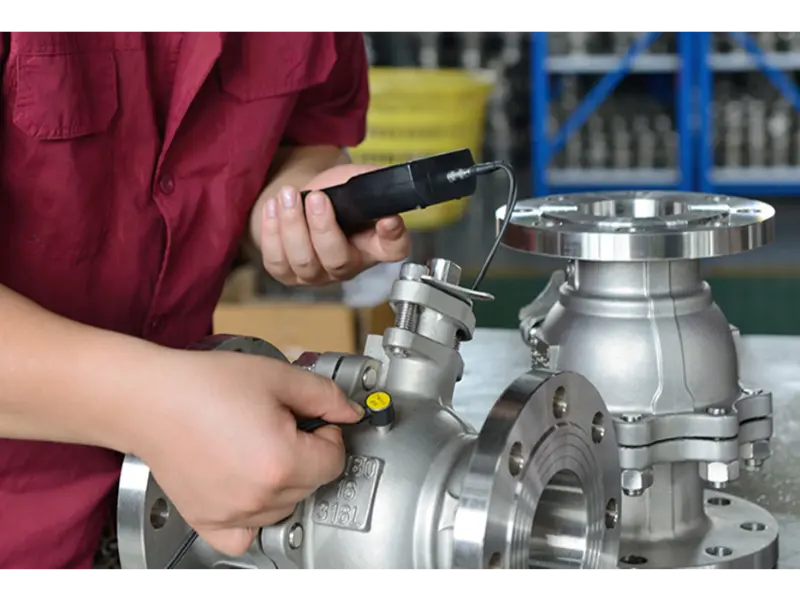
Take HUADU Valve Group as an illustration. Operating out of Wenzhou, the company has structured its production so that the same traceability and testing rigor applied to API 6D ball valves also flows into its Y-type filter line. Raw WCB castings enter the plant and immediately undergo spectrographic analysis to confirm chemistry against ASTM A216. Throughout machining, in-process checks every two hours monitor flange face finish and screen weld integrity. Final pressure tests follow API 598 as a standard sequence, not an optional extra. The company's MES (Manufacturing Execution System), deployed in 2024, records torque values, machining parameters, and test dwell times against each filter's serial number. For a project engineer or third-party inspector, this means the data behind a certified Carbon Steel Flanged Y-type Filter is retrievable and auditable.
Technical Parameters Worth Reviewing.
For anyone tasked with specifying or purchasing a certified Carbon Steel Flanged Y-type Filter, a clear datasheet is the starting point. The table below lists the parameters typically covered under a standard certification package, based on HUADU's documented specifications. These are not laboratory ideals; they reflect what a supplier with a finished-product acceptance rate above 99.8% delivers as a matter of routine.
Certified Specifications – Carbon Steel Flanged Y-type Filter
| Parameter | Certified Specification | Standard Applied |
|---|---|---|
| Body Material | ASTM A216 WCB, fully traceable | ASTM A216 / ASME B16.34 |
| Size Range | DN15 – DN500 (½" – 20") | ASME B16.34 / API 598 |
| Pressure Class | Class 150 – 2500 (PN16 – PN420) | ASME B16.5 / EN 1092-1 |
| Shell Test Pressure | 1.5 × Rated Working Pressure | API 598 |
| Seat Test Pressure | 1.1 × Rated Working Pressure | API 598 |
| Screen Material | SS304 / SS316 / SS316L, seamless cone | ASTM A240 |
| Filtration Precision | 50 – 3000 microns (60 mesh standard) | Per client specification |
| End Connection | Flanged RF per ASME B16.5 | ASME B16.5 / EN 1092-1 |
| Design Temperature | -29°C to 425°C (-20°F to 800°F) | ASME B16.34 pressure-temperature rating |
| Documentation Package | MTC 3.1, hydro test report, NDE on request | EN 10204 / ISO 10474 |
WCB Material Certification Data
| Element / Property | Specification Limit | Verification Method |
|---|---|---|
| Carbon | ≤ 0.30% | OES Spectrometer |
| Tensile Strength | 485-655 MPa | Universal Testing Machine |
| Yield Strength | ≥ 250 MPa | Universal Testing Machine |
| Elongation | ≥ 22% | Extensometer |
| Impact Toughness | 20J at -20°C (when specified) | Charpy V-notch |
| Hardness | ≤ 190 HBW | Brinell Hardness Tester |
Having these numbers documented and traceable is what turns a general product description into a certifiable engineering document.
FAQ:
1. Why is API certification important for a Carbon Steel Flanged Y-type Filter in oil and gas projects?
API 598 testing proves the filter body holds 1.5× rated pressure without leakage and the seat seals with zero visible leak. This removes rupture risk during pressure surges and simplifies third-party inspection for EPC contractors.
2. How does HUADU ensure CE/PED compliance for every filter?
HUADU builds compliance into production: spectrometer-verified WCB castings, qualified weld procedures, and API 598 hydrostatic tests. Each Carbon Steel Flanged Y-type Filter ships with an EN 10204 Type 3.1 certificate and a declaration of conformity for fluid group 1 service.
3. Can a certified filter really prevent catastrophic failure?
It reduces probability through layered safeguards: verified material integrity, shell testing at 1.5× MAWP, seamless screen design with a 4:1 open area ratio, and full test traceability. These measures turn a strainer into an auditable safety device rather than a hidden risk.
Where This Leaves the Project Engineer?
Safety is not a feature that can be bolted on after procurement. It is the cumulative result of material decisions, manufacturing process control, and independent verification. On a major project, specifying a Carbon Steel Flanged Y-type Filter that carries API and CE certification shifts the conversation from "trust us" to "here is the data." Manufacturers that have aligned their entire production system—material receiving, CNC machining accuracy, MES traceability, standardized pressure testing—make that data available as a matter of course. When the next project specification lands on your desk, the question is not whether certification adds cost, but whether operating without it is a risk worth carrying.
Related News
- The characteristics of ball valves.
- The working principle of the check valve.
- The working principle and features of Globe Valve.
- Types of gate valves.
- Why Do Global Industrial Buyers Trust Huadu for High-Quality Globe Valve Solutions?
- How to Choose A Reliable Sealing Valve for Long-Term Industrial Pipeline Operation?
Leave me a message